
Written by the Marshfield Electric team · Reviewed by Robert Thomas, Massachusetts Master Electrician, License #23521-A
Generator interlock kit installation gives homeowners with compatible panels a safe way to power household circuits with a portable generator. A mechanical plate keeps the utility and generator breakers from being used together. Straightforward installations can take two to four hours on the South Shore. Marshfield Electric checks compatibility with your panel, installs the connection, and explains how it operates.
Generator interlock kit installation covers the process of setting up a sliding metal plate on your breaker panel so a portable generator can power your home without sending electricity back onto utility lines. When a nor'easter knocks out power on the South Shore, your worries can add up fast: food in the fridge, water in the basement, and your home getting colder by the hour. A generator cannot fully power essentials when it is only connected through extension cords.
An interlock kit solves the connection problem. Your generator is plugged into an outdoor inlet, and the plate lets only one power source feed the electrical panel at a time: utility power or generator power, never both. Marshfield Electric plans the connection around your panel, backup generator, and essential equipment.
Have your panel details and generator model ready so we can discuss the right starting point.
For most homes with a portable generator, an interlock kit offers the most flexibility for the cost. Extension cords may work with a generator to power a fridge or a lamp, but they cannot reach hardwired equipment like a furnace or well pump. A homemade cord plugged into a dryer outlet is also not a safe substitute, as it can push generator power back onto the utility lines.
A manual transfer switch covers selected circuits, while other transfer switches can serve broader load. An interlock uses the existing panel in your home, which means you can run any circuit your generator can handle. The right connection depends on what you need to power and how much manual operation you want.
A generator interlock kit makes backfeeding impossible. That protects line crews and the equipment in your home.
When utility service returns, the interlock keeps the generator supply separated from it. This helps prevent backfeeding, where generator power moves through your panel and onto utility lines. The interlock plate keeps the generator breaker off until the main breaker is off.
The pole transformer can boost backfed power to thousands of volts. A worker who repairs the line and expects a dead line can be seriously hurt, and an interlock removes that danger for your home and line workers.
If a generator is still tied in when utility service comes back, both sources can collide and damage the generator and nearby wiring. An interlock keeps the main power off until you switch power manually.
You can prioritize suitable loads such as refrigeration, lighting, or a sump pump. Your generator’s starting and running capacity determines what can operate together. Having access to panel circuits does not mean every circuit can run at once.
An interlock usually costs less than a transfer switch setup because it works with your existing panel. Your essentials can all run, one circuit at a time, all within your generator's limit.
Every generator interlock kit installation starts with equipment checks and ends with a final test and operating instructions. Each step helps safely establish a connection that suits your home and panel.
We review your panel’s brand, model, condition, breaker layout, and generator specifications. We also discuss which circuits you want powered and size the breaker, wire, and inlet to your generator. Lastly, we identify required permits before scheduling the work.
Our electrician establishes the required isolation area, turns off the main power, and verifies electrical conditions before panel work begins. Turning off the main breaker alone does not remove power from every part of a service panel. Some incoming utility connections may still remain energized.
We prepare the panel for the approved arrangement and make planned circuit adjustments. We make space for the generator breaker, sometimes by moving a few breakers, then mount the interlock and close the panel. If we find additional problems in the electrical panel, we explain them clearly before proceeding. No electrical or wiring work is done outside our agreed scope.
We follow the planned wiring route, with allowance for access and weather exposure. The installation is secured and protected where it passes through walls and clear of windows, doors, and vents.
Our licensed electricians check that the electrical connection and interlock function works as intended. We also coordinate the required local inspection, and show you how the generator operates with the interlock kit. Once the inspector signs off on the work, your system is ready for the next outage.
Most straightforward generator interlock installations take two to four hours, and can run longer with extra wiring or panel corrections.
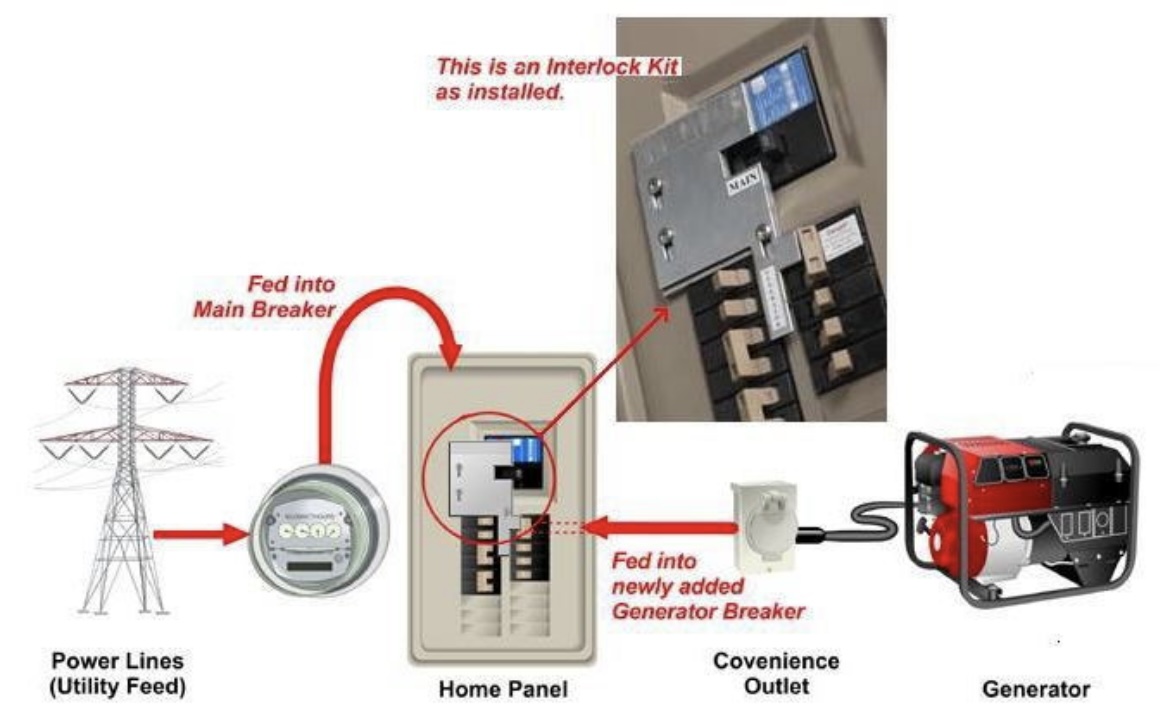
The right inlet size should match your generator's largest outlet, not the size of your house. The home essentials you want to run during an outage and your budget also play a part.
A 30-amp generator interlock kit fits many mid-size portable generators with a 30-amp twist-lock outlet. It handles home essentials like the fridge, furnace, well pump, and some lighting circuits. The main tradeoff is less room for large loads like central air conditioning or an electric range.
A 50-amp setup suits larger portable generators with a 50-amp outlet, which lets you run more circuits at once. The main tradeoff is the cost, since heavier wire and a larger inlet add to the job. Choosing a 50-amp interlock and inlet only pays off if your generator can supply that power.
During the panel inspection, we also review your generator's outlet and the circuits you want to stay on during an outage. We recommend the interlock kit size that fits your panel, your generator, and your essentials.
Most interlock installations cost between $800 and $1,500, which covers the kit, breaker, inlet, wiring, labor, and permit processing. Here are the factors that can drive your generator interlock installation cost:
Panel Compatibility: A common panel with a listed kit is the simplest job. Older panels may need an electrical panel upgrade or additional work first.
Panel Location: A panel on an outside wall keeps the wire run short. One in a finished basement adds conduit, wire, and labor.
Inlet Size: A 50-amp setup requires heavier wire and a larger inlet than a 30-amp setup.
Breaker Space: Repositioning circuits or correcting existing problems require additional cost and labor.
Permit and Inspection Fees: Massachusetts requires an electrical permit for generator interlock kit installation, and permit fees vary by town.
Marshfield Electric provides a clear estimate and explains in detail whether that involves a generator cord, panel corrections, and permit fees.
Marshfield Electric is owned and operated by Robert Thomas who oversees every interlock installation. He is a Massachusetts Master Electrician (License #23521-A) with more than 20 years in the trade. That means one licensed pro stays responsible for your connection.
Generator safety is a core part of our work, from portable generator hookups to permanent generator systems. Our team pulls the permit, schedules inspections in-house, and recommends and installs the right kit, breaker, and inlet.
If an outage leaves you with a damaged inlet or a generator that does not power your home, our team is available and provides 24/7 emergency electrical service across the South Shore.
⭐⭐⭐⭐⭐ "Emily was knowledgeable, efficient and professional! I am very happy to give her a 5 star review 🤩" – Maureen C., Verified Customer
⭐⭐⭐⭐⭐ "Very knowledgeable and pays attention to details. Professional from start to finish. Rob Thomas and crew rocks!" – Jennifer S., Verified Customer
Marshfield Electric serves South Shore homeowners from our home base in Marshfield. Generator interlock installation is available in Scituate, Pembroke, Norwell, and Hanover.
Homeowners in Duxbury, Plymouth, and Weymouth also get the same panel check, permit, and installation process. Wherever you are located on the South Shore, we plan each connection around your panel location, wiring access, and your property’s suitable outdoor space.
Generator interlock kit installation requires a site-specific estimate based on your panel, inlet, and wiring needs. Ask whether the quote already includes permits, breaker hardware, labeling, and testing. Comparing the complete installation scope gives you a clearer basis for deciding on estimates than comparing how the kit costs alone.
Expect the power to be off during the two to four hour visit, while breakers are installed or circuits are moved. A closed fridge and freezer can stay cold through that window. Our team will let you know before shutting off the main power and when to turn power back on.
No, an interlock does not start your generator automatically. You must be present to connect and operate the equipment. If you want backup power that starts without manual setup, discuss suitable alternatives through our generator installation service. The right option depends on your power needs, property, and budget.
Yes, a generator interlock kit is legal in Massachusetts when it is listed for your panel and installed with an electrical permit. Your town’s inspector reviews the kit, breaker, inlet, and labels before approving the work. A homemade cord plugged into a dryer outlet is not legal and is dangerous for your home and line workers.
Watch for neighbors’ lights or check the utility’s outage map, as a generator interlock kit does not signal when utility power returns. When the utility power is back on, safely turn off the generator breaker, slide the plate, and turn the main power source back on.
We will schedule a visit to look at your panel, your generator, and the outside wall. You will get a written estimate that outlines the kit, breaker, and what the work involves. If your panel is not a good candidate, we explain what would work instead.
Contact our team or call (781) 566-0306 for a generator interlock kit estimate. Each job is properly permitted, safely installed, and inspected by the town.